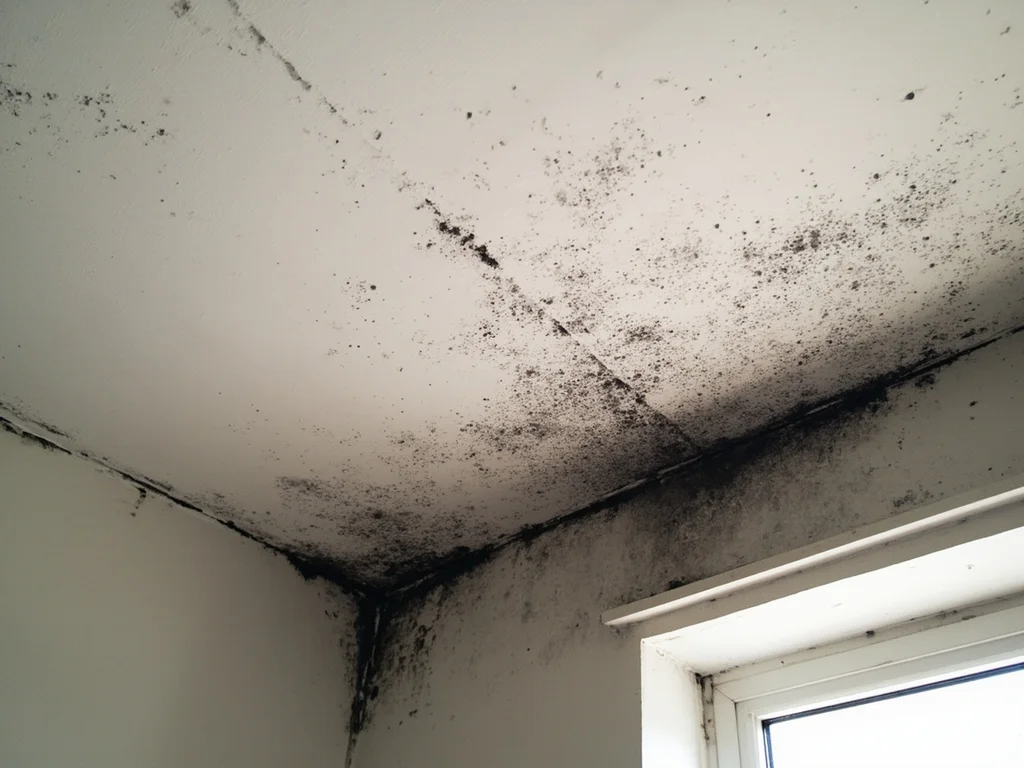
Why mould grows on ceilings
Mould grows on ceilings when three conditions are met: moisture, a food source and warmth. UK ceilings provide all three.
The moisture comes from humidity in the room steam from showers and baths, cooking, and drying clothes indoors. Ceiling height means warm, moist air rises and collects at the top of the room first, making the ceiling the first surface it contacts. The ceiling surface and any paint or wallpaper paste provides organic material for mould to feed on.
Bathrooms and kitchens are the most common places for ceiling mould, but any room with persistent condensation a poorly ventilated bedroom, a living room with single-glazed windows can develop it over time. Bedrooms with en-suite bathrooms are a frequent example: steam enters the bedroom, humidity rises, and mould grows on the ceiling above the bathroom doorway.
How bad is ceiling mould?
Most common black mould on ceilings usually Cladosporium, Aspergillus or Penicillium species causes irritation rather than serious illness in healthy people. Symptoms include eye irritation, coughing, wheezing and skin irritation. People with asthma, allergies, respiratory conditions or weakened immune systems are more vulnerable.
Mould that grows after a water leak or flood, or mould covering a large area (more than a square metre), should be assessed by a professional. If the mould is thick, discoloured or has a strong musty smell, do not repeatedly treat it yourself get a professional damp and mould treatment assessment.
How to treat mould on a ceiling
For small, isolated patches, you can treat ceiling mould yourself:
- Prepare the room: Open windows and ensure good ventilation. Wear a mask (at least an FFP2) and rubber gloves. Lay a dust sheet on the floor.
- Apply treatment: Use a dedicated anti-mould spray for ceilings, a mould treatment solution, or a diluted bleach solution (one part bleach to four parts water) for hard surfaces. Spray or apply with a cloth do not scrub aggressively as this spreads spores.
- Leave to work: Most products need 1530 minutes to penetrate the mould. Check the product instructions.
- Wipe clean: Wipe the area with a clean, damp cloth. Rinse the cloth frequently.
- Dry the surface: Ensure the treated area is thoroughly dry. A dehumidifier in the room helps speed this up.
- Consider mould-resistant paint: Once the area is completely dry, applying a mould-resistant paint or emulsion topcoat adds a layer of protection against regrowth. This is not a substitute for fixing the humidity problem, but it helps.
For large areas, repeated occurrences, or thick mould growth, hire a professional damp specialist.
How to prevent ceiling mould coming back
Treating the mould without fixing the moisture source is pointless it will return. The most effective prevention is reducing the humidity in the room so the ceiling surface never stays damp long enough for mould to grow:
- Use an extractor fan every time you shower or cook and leave it running for 15 minutes after
- Open windows for at least 10 minutes after high-moisture activities, even in winter
- Run a dehumidifier in the room, especially in winter when windows are kept closed and humidity builds up
- Keep bathroom and kitchen doors closed when showering or cooking to prevent humid air spreading to other rooms
- On bathroom ceilings, use mould-resistant paint after treatment it contains additives that resist mould regrowth, though it does not replace humidity control
- Check room corners and ceiling edges regularly so you catch any early regrowth before it spreads
When to get professional help for ceiling mould
Call a professional damp and mould treatment specialist if:
- The mould covers more than about one square metre
- It returns within weeks of treatment regardless of what you do
- You can smell mould but cannot see it it may be behind plaster, in the loft or inside walls
- The mould appeared after a water leak, burst pipe or flooding
- Anyone in the household has unexplained respiratory symptoms, worsening allergies or asthma
- The ceiling is stained, sagging or damaged there may be a water source you cannot see