Capacity
Small rooms may only need compact units, while laundry drying, open-plan spaces and persistent damp usually need larger extraction capacity.
UK home moisture help
Indoor laundry can add a lot of moisture to the air. Choose a unit that can extract quickly and run safely in the space you use.
Drying Clothes Indoors
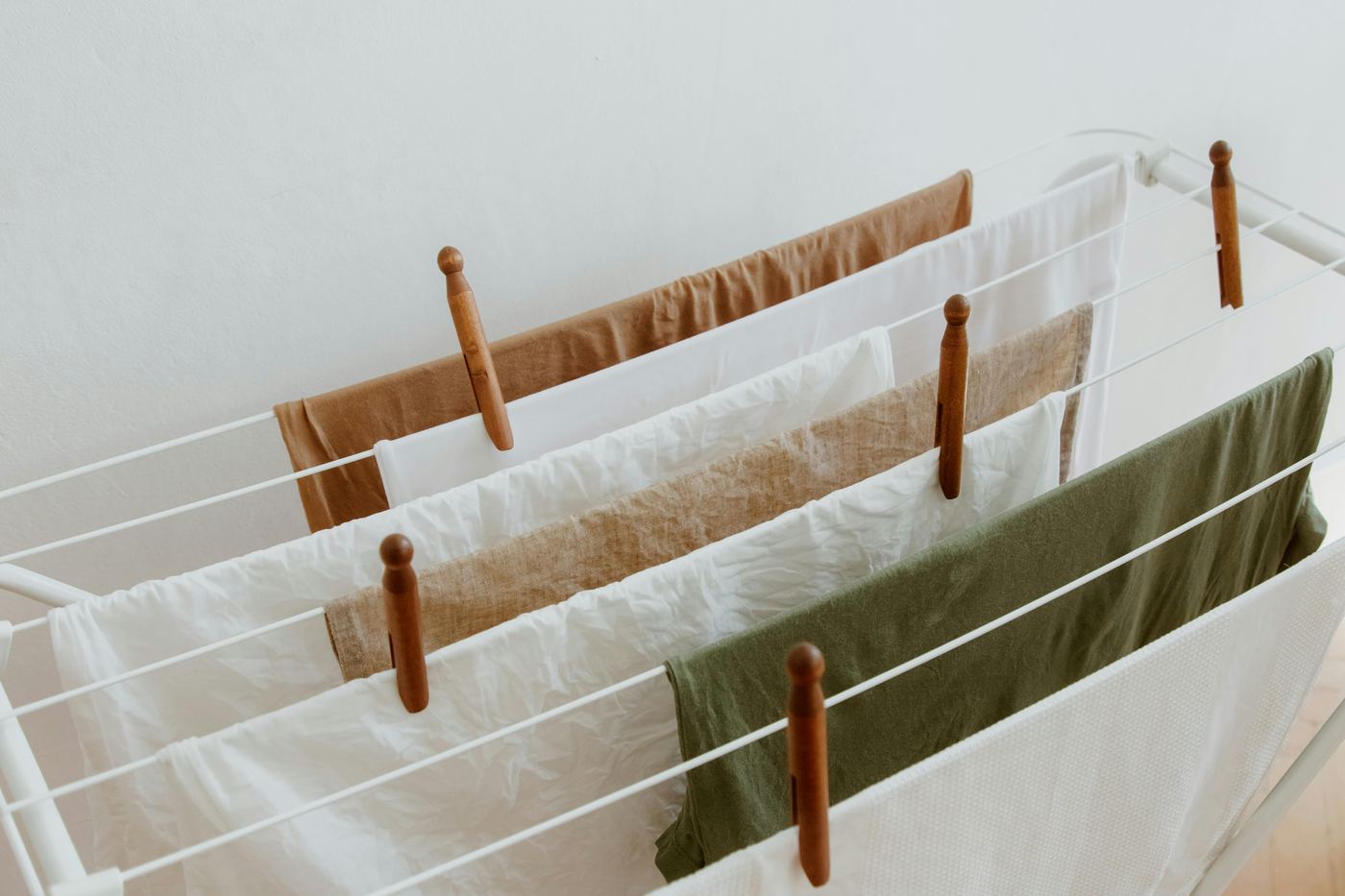
Indoor laundry releases a lot of moisture, so airflow and extraction capacity matter.
Start with the room and the symptom. Is the problem mainly morning condensation, a musty smell, visible mould, slow laundry drying, or damp marks that suggest water ingress? The right product depends on the cause.
For ordinary condensation and high humidity, measuring the room with a hygrometer is a useful first step. For staining, leaks, crumbling plaster or tide marks, investigate the building issue rather than only buying a dehumidifier.
Small rooms may only need compact units, while laundry drying, open-plan spaces and persistent damp usually need larger extraction capacity.
Bedrooms and offices need quieter operation. Garages and utility areas can usually tolerate more noise if extraction performance is better.
Check wattage and likely hours of use. Use our running cost calculator before assuming a bigger unit is too expensive to run.
Start with the problem you are actually trying to solve. A dehumidifier for drying laundry every day has different priorities from a quiet unit for a bedroom or a machine for a colder garage. Think about the room temperature, how often moisture is created, whether you can drain continuously, and how easily you can empty the tank.
Do not buy only from the headline litres-per-day number. That figure is usually measured in favourable test conditions, and real UK homes are often cooler. Also check noise level, physical size, tank capacity, auto-restart, humidity target, laundry mode and warranty support.
If there are leaks, overflowing gutters, failed seals, damp patches after rain, tide marks, crumbling plaster or a persistent wet wall, investigate the source of water first. A dehumidifier can reduce airborne moisture, but it cannot repair building defects. For suspected structural damp, get appropriate professional advice before spending heavily on appliances.
For many homes, the best setup is a dehumidifier plus a cheap digital hygrometer, consistent ventilation habits and careful furniture placement away from cold external walls. Mould remover can clean existing staining, but moisture control is what helps stop it returning.
Laundry is the hardest job you can ask a domestic dehumidifier to do. A wet wash load is a large, sustained source of moisture in a single room, and it is usually dried in a bathroom, utility room or spare bedroom where nobody wants to leave a window open in January. That changes which specifications matter.
| Feature | Why it matters for laundry | What to look for |
|---|---|---|
| Extraction rate | Sets how quickly the load dries | 12-16 L/day for one drying room; 20 L/day+ for daily family washing or open-plan |
| Laundry mode | Runs the unit at maximum extraction for a fixed period instead of to a humidity target | Useful rather than essential - a unit with a low setpoint can be left running instead |
| Continuous drainage | The single most important feature for laundry | A hose outlet you can run to a drain or sink; expect an emptied tank every few hours without it |
| Tank size | Only matters if you cannot drain continuously | 4 L+ if the tank is your only route |
| Operating temperature | Utility rooms, garages and conservatories get cold | Compressor above roughly 15C; desiccant for cold rooms |
| Airflow direction | Drying is faster when air moves across the fabric | Adjustable louvre or a laundry airflow setting aimed at the airer |
| Humidity setpoint | Stops the unit once the room is dry | Adjustable target, typically down to about 40% RH |
| Auto-defrost | Stops the coil icing in a cold room | Essential for garages, cellars and conservatories |
| Timer | Lets the unit run while you are out | 2, 4 and 8 hour options are the useful ones |
The priority order is different from a bedroom. For laundry, drainage beats tank size, extraction rate beats noise, and a laundry mode is a convenience rather than a requirement.
The brands that come up most often on UK laundry-focused listings include Meaco, EcoAir, Pro Breeze, De'Longhi, Inventor, Ebac, VonHaus, NETTA, ANSIO, PureMate and Russell Hobbs. Several of them make both compressor and desiccant models, and many smaller names rebadge the same factories.
We do not rank or recommend specific models, because we have not tested them. What we can tell you is what you are paying for at the top of the range: quieter fans, a more sensitive humidity sensor, a larger coil that keeps extracting in cooler air, drain fittings that do not weep, and better warranty support. For laundry use, the drain fittings and the warranty are the two that matter most in practice.
Shortlist on specification first, then compare price and warranty. For the underlying technology, see compressor vs desiccant dehumidifiers and continuous drainage vs tank.
Cost is the appliance rated power in kilowatts multiplied by the hours it runs, multiplied by your electricity unit rate. The examples below use an assumed rate of 25p per kWh and typical session lengths. Use your own tariff and the rated power on the appliance label, because both vary.
| Method | Typical power | Typical session | Approx. cost per load |
|---|---|---|---|
| Dehumidifier (compressor) | 250-400 W | 5 hours | 31-50p |
| Heated airer | 250-300 W | 6 hours | 38-45p |
| Vented or condenser tumble dryer | 2.5-4 kW | 1.5-2 hours | 94p-2.00 |
| Heat pump tumble dryer | 1-1.5 kW | 2-3 hours | 50-75p |
A dehumidifier is usually the cheapest method per load, but it is slow, and it only works well when air can reach the fabric and the room is closed. A heat pump dryer is faster and needs no room management. A vented dryer is the quickest and the dearest to run. Many homes end up with a combination: a dehumidifier for everyday drying in a spare room, and a dryer for towels and bedding.
Put your own numbers into the running cost calculator, and see the full comparison in dehumidifier vs tumble dryer running cost.
If the problem appears mainly after sleeping, showering, cooking or drying laundry, it is often condensation-related and can usually be improved with humidity monitoring, ventilation habits and the right size dehumidifier. If the problem gets worse after rain, appears as localised staining, or stays wet even when the room is ventilated and heated, treat it as a possible repair issue first.
Drying clothes indoors is one of the highest-load dehumidifier tasks. Laundry mode, extraction rate, tank size and running costs are the main comparison points.
| Type | Laundry mode | Extraction rate | Tank size | Running cost estimate |
|---|---|---|---|---|
| Compressor 12-16L | Yes dedicated mode | 12-16L/day | 2-3 litres | Medium ~15-25p/hour |
| Compressor 20L+ | Yes high extraction | 20L/day+ | 4-5 litres | Medium-high ~20-35p/hour |
| Desiccant with laundry | Yes strong in warmth | 12-18L/day | 2-3 litres | Higher ~25-40p/hour |
| Heat pump dryer combo | Yes integrated | Very high | Continuous drain | Higher initial cost |
Laundry drying needs high extraction and the right features. Pick your priority below. We do not rank or recommend individual models, because we have not tested them.
16-20L, laundry mode, large tank
Compare laundry dehumidifiers12-16L, good extraction, lower running cost
Compare budget laundry dehumidifiersDrain hose ready, set-and-forget laundry drying
Compare drain-hose dehumidifiersUse the dehumidifier size calculator and running cost calculator before choosing a model.
Type to search all DampHomeFix guides, tools and buying pages.