Capacity
Small rooms may only need compact units, while laundry drying, open-plan spaces and persistent damp usually need larger extraction capacity.
UK home moisture help
A practical buying guide for choosing a dehumidifier that fits your room, moisture problem and budget.
Dehumidifier Room
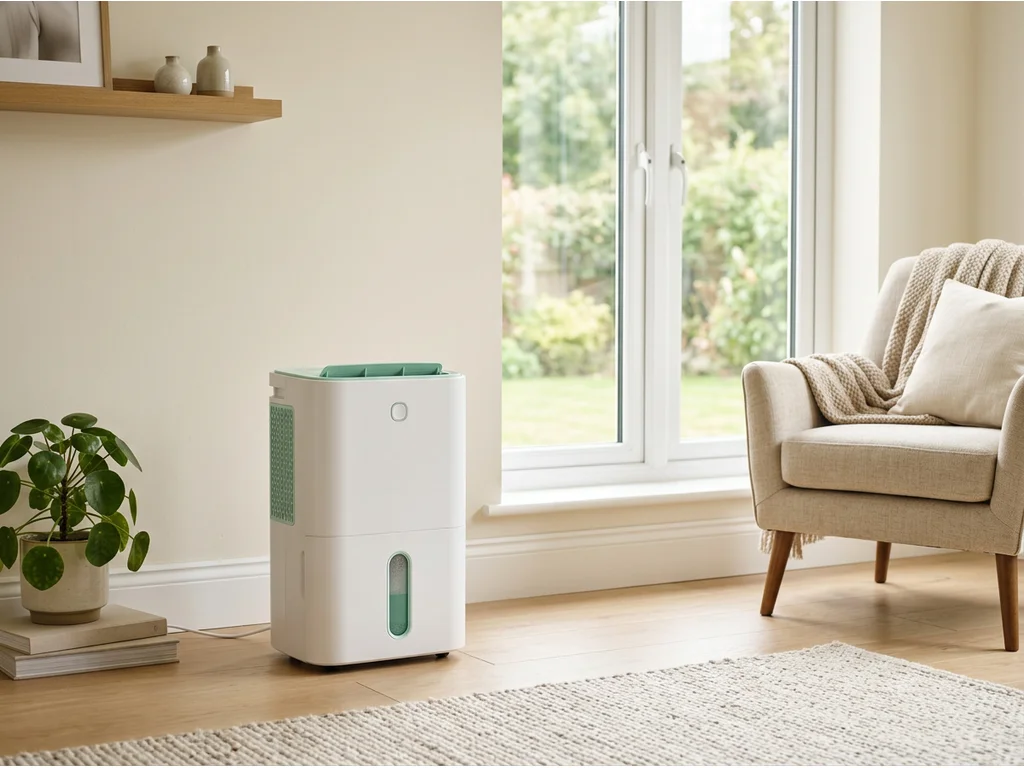
A real home-room photo works better for comparing capacity, room fit, laundry use and running cost.
Start with the room and the symptom. Is the problem mainly morning condensation, a musty smell, visible mould, slow laundry drying, or damp marks that suggest water ingress? The right product depends on the cause.
For ordinary condensation and high humidity, measuring the room with a hygrometer is a useful first step. For staining, leaks, crumbling plaster or tide marks, investigate the building issue rather than only buying a dehumidifier.
Small rooms may only need compact units, while laundry drying, open-plan spaces and persistent damp usually need larger extraction capacity.
Bedrooms and offices need quieter operation. Garages and utility areas can usually tolerate more noise if extraction performance is better.
Check wattage and likely hours of use. Use our running cost calculator before assuming a bigger unit is too expensive to run.
Start with the problem you are actually trying to solve. A dehumidifier for drying laundry every day has different priorities from a quiet unit for a bedroom or a machine for a colder garage. Think about the room temperature, how often moisture is created, whether you can drain continuously, and how easily you can empty the tank.
Do not buy only from the headline litres-per-day number. That figure is usually measured in favourable test conditions, and real UK homes are often cooler. Also check noise level, physical size, tank capacity, auto-restart, humidity target, laundry mode and warranty support.
If there are leaks, overflowing gutters, failed seals, damp patches after rain, tide marks, crumbling plaster or a persistent wet wall, investigate the source of water first. A dehumidifier can reduce airborne moisture, but it cannot repair building defects. For suspected structural damp, get appropriate professional advice before spending heavily on appliances.
For many homes, the best setup is a dehumidifier plus a cheap digital hygrometer, consistent ventilation habits and careful furniture placement away from cold external walls. Mould remover can clean existing staining, but moisture control is what helps stop it returning.
Most UK listings lead with a litres-per-day figure. That number is measured at a standard test condition of 30C and 80% relative humidity. A typical heated UK living room in winter sits nearer 18-21C and 60-70% RH, so the real extraction rate is usually a good deal lower than the headline. Treat the headline figure as a way to compare units against each other, not as what you will collect in your front room.
| Spec | What it actually tells you | What to look for |
|---|---|---|
| Extraction rate | Litres per day at 30C / 80% RH - not your room | Match to room size and moisture load; expect less in a cool room |
| Operating temperature range | Whether a compressor unit will keep working in a cold room | Compressor: usually best above 15C. Cold rooms: desiccant |
| Noise level (dB) | Whether you can sleep or work near it | Under 40 dB for a bedroom; 45 dB+ is fine in a garage |
| Tank size | How often you empty it | 2-3 L needs emptying daily in damp weather; 4 L+ is easier |
| Continuous drain | Whether you can leave it running unattended | Hose outlet plus a drain lower than the unit |
| Humidity setpoint | Whether it switches itself off at target | Adjustable target (typically 40-60% RH) rather than on/off only |
| Auto-restart | Whether it resumes after a power cut | Useful for cellars, caravans and outbuildings |
| Defrost / auto-defrost | Whether the coil ices up in cold weather | Essential for garages, cellars and conservatories |
| Warranty and UK support | What happens if it fails in year two | Check the length and who handles the claim |
A cheaper unit that meets your spec is often the right one. But an undersized unit will run constantly, collect little and cost more in electricity than a correctly sized one that switches itself off.
Dehumidifiers are sold under a relatively small number of brands. The names that come up most often in UK retailers and marketplaces include Meaco, EcoAir, Pro Breeze, De'Longhi, Inventor, Ebac, VonHaus, NETTA, ANSIO, PureMate and Russell Hobbs. Several of these make both compressor and desiccant models, and many smaller brands rebadge the same factories.
We do not rank or recommend specific models on this site, because we have not tested them. What we can tell you is where the money goes in a more expensive unit: quieter fans and better acoustic damping, a more accurate humidity sensor, a larger coil that extracts more in cool air, continuous-drain fittings that do not leak, and longer warranty support. Those differences matter most in bedrooms and in rooms where you run the unit for hours at a time. For a garage you use occasionally, the gaps are smaller.
The practical approach is to shortlist three or four units that meet your spec - extraction, temperature range, noise, tank and drain - then compare current price and warranty. The badge matters less than the specification. For the underlying differences, see compressor vs desiccant dehumidifiers, continuous drainage vs tank and what makes a bedroom dehumidifier quiet.
Running cost is the unit wattage multiplied by the hours you run it, multiplied by your electricity unit rate. Two worked examples, using an assumed rate of 25p per kWh. Check your own tariff, because the figure on your bill is the one that applies to you.
Compressor units are usually the cheaper choice in a warm, occupied room. Desiccant units draw more power but keep extracting when the air is cold, which is why they are common in garages, cellars and caravans. Either way, a unit that is correctly sized for the room reaches its target sooner and costs less than one that is too small and runs all day.
Put your own wattage, hours and unit rate into the running cost calculator to see it for your room.
If the problem appears mainly after sleeping, showering, cooking or drying laundry, it is often condensation-related and can usually be improved with humidity monitoring, ventilation habits and the right size dehumidifier. If the problem gets worse after rain, appears as localised staining, or stays wet even when the room is ventilated and heated, treat it as a possible repair issue first.
Room size and the severity of the moisture problem determine the right capacity. UK homes are typically cooler than test lab conditions, so real-world performance is usually lower than the headline figure.
| Room / Home Type | Suggested Capacity | Typical Use |
|---|---|---|
| Small bedroom or study (under 20m) | 510 litres/day | Compact or desiccant unit |
| Master bedroom, living room (2040m) | 1016 litres/day | Mid-range compressor unit |
| Open-plan kitchen/living (4070m) | 1620 litres/day | Larger compressor or dual-machine setup |
| Whole 2-bed house (all rooms) | 20+ litres/day or multiple units | Whole-house dehumidifier or one per floor |
| Cold or unheated room (garage, cellar, caravan) | Desiccant type regardless of size | Desiccant copes better in cooler temperatures |
Compressor dehumidifiers work like a fridge they cool air to condense moisture and work best in warm rooms above 15C. Desiccant units use a absorbent wheel and heating element they work in cooler temperatures and in enclosed spaces like garages, cellars and caravans but use more electricity.
For most occupied UK rooms (bedrooms, living rooms, kitchens), a compressor unit is more energy-efficient. For cold rooms, a desiccant unit is the better choice.
If you are dealing with moisture across multiple rooms or a whole floor, you have three main routes:
For most UK homes, a mid-range portable unit (1620 litres/day) in a central living space with doors open is the most cost-effective whole-house approach.
Pick your situation below. Each link opens a targeted Amazon UK search so you can compare current models, prices and reviews yourself. We do not rank or recommend individual models, because we have not tested them.
Low-noise compressor, 10-12L, sleep mode, compact
Compare bedroom dehumidifiersHigh extraction, 16-20L, large tank or continuous drain
Compare high-capacity dehumidifiersDesiccant type, works below 15C, no compressor
Compare desiccant dehumidifiers20L+, open-plan, multiple rooms, laundry loads
Compare whole-house dehumidifiersUse the dehumidifier size calculator and running cost calculator before choosing a model.
Type to search all DampHomeFix guides, tools and buying pages.